Última actualización: March 12, 2026 | Número de palabras: 3,800+ | Tiempo de lectura: 15 minutos
Editor’s Note: This ultimate guide covers everything engineers need to know about selecting ROV connectors—from depth ratings and materials to pin configurations and supplier evaluation. Based on 500+ successful deployments across 30+ countries.
Introduction: Why Connector Selection Can Make or Break Your ROV
You’ve spent months designing your ROV. Carefully selected thrusters, cameras, sensors, and control systems. Tested everything in the pool. Everything works perfectly.
Then you deploy to 200 meters. One connector fails. Water ingress. Short circuit. Your ROV sinks—or worse, floats back up with fried electronics.
We’ve seen this scenario dozens of times. And every time, the root cause traces back to one decision: choosing the wrong connector.
Here’s what most ROV builders don’t realize until it’s too late:
- Las tasas de fallos de los conectores varían hasta 10 veces entre los distintos proveedores
- “Compatible” no siempre significa “intercambiable”
- Depth rating isn’t just about pressure—it’s about safety margins
- El conector más barato suele acabar costando entre tres y cinco veces más en términos de costo total de propiedad
In this comprehensive guide (3,800+ words), we’ll cover everything you need to know about ROV connector selection:
- Understanding depth ratings and what they really mean
- Material selection: 316L vs titanium vs aluminum (with cost-benefit analysis)
- Pin configuration and electrical specifications
- Wet-mate vs dry-mate: Which does your ROV actually need?
- IP68 vs IP69K: Do you need the higher rating?
- Subconn compatibility: When alternatives make sense
- Supplier evaluation checklist (7 critical factors)
- 5 red flags that should make you walk away
- 3 real case studies with cost breakdowns
Recursos relacionados: ROV & AUV Connector Solutions | Especificaciones técnicas | Product Catalog
Chapter 1: Understanding Depth Ratings (Don’t Guess, Verify)
1.1 What Depth Rating Actually Means
Depth rating isn’t a single number—it’s a combination of factors:
Static Pressure Rating
Constant pressure at a specific depth. This is the baseline rating most manufacturers provide.
Pressure calculation:
- Every 10 meters of seawater = 1 bar (14.5 PSI) of pressure
- 100m depth = 10 bar + 1 bar atmospheric = 11 bar total
- 500m depth = 50 bar + 1 bar atmospheric = 51 bar total
Dynamic Pressure Rating
Pressure spikes during deployment/recovery. When an ROV moves through water, it experiences additional pressure beyond static depth.
Ejemplo: An ROV deployed at 200m static depth might experience 220-250m equivalent pressure during dynamic operations.
Pressure Cycling
Repeated compression/decompression weakens materials over time. This is critical for ROVs that dive frequently.
- Low-cycle ROV: <50 dives/year (research, occasional inspection)
- Medium-cycle ROV: 50-200 dives/year (regular inspection work)
- High-cycle ROV: >200 dives/year (commercial operations, aquaculture)
High-cycle applications need connectors rated for more pressure cycles.
1.2 Safety Margins: The 1.5x Rule
Industry standard: Connector depth rating should be at least 1.5x your maximum operating depth.
| Profundidad máxima de funcionamiento | Minimum Connector Rating | Recommended Rating |
|---|---|---|
| 50m | 75m | 100 m |
| 100 m | 150m | 200m |
| 200m | 300 m | 500m |
| 500m | 750m | 1000 m |
| 1000 m | 1500m | 2000m |
Why the safety margin matters:
- Accounts for dynamic pressure during deployment
- Compensates for material degradation over time
- Provides buffer for unexpected depth excursions
- Reduces failure risk in marginal conditions
1.3 Certification Standards That Matter
| Estándar | Qué evalúa | Requisitos mínimos | Notas |
|---|---|---|---|
| IP68 | Inmersión continua a más de 1 m | Obligatorio | Depth/duration specified by manufacturer |
| IP69K | High-pressure, high-temp water jets | Optional | Nice for washdown, not essential for most ROVs |
| ASTM B117 | Corrosión por niebla salina (horas) | Más de 1000 horas | Tests corrosion resistance |
| IEC 60529 | Clasificación de protección contra la entrada de partículas y líquidos | Obligatorio | Defines IP rating system |
| MIL-DTL-24308 | Normas sobre conectores militares | Optional | Premium applications only |
| DNV-OS-F101 | Sistemas de producción submarina | Optional | Oil & gas applications |
Señal de alerta: Proveedores que no pueden presentar documentación de pruebas realizadas por terceros. No es aceptable decir “Confía en nosotros, no hay problema”.
1.4 Questions to Ask Every Supplier
- ¿Pueden proporcionar certificados de pruebas independientes (que no sean pruebas internas)?
- ¿Qué margen de seguridad me recomienda para mi aplicación?
- ¿Ha realizado pruebas hasta el fallo? ¿Cuál fue la profundidad real del fallo?
- ¿Garantizan ustedes las especificaciones de profundidad?
- ¿Puedo presenciar las pruebas de las configuraciones personalizadas?
- How does pressure cycling affect the rating?
Chapter 2: Material Selection (Corrosion Resistance Explained)
2.1 Why Materials Matter
El agua salada es implacable. Los materiales convencionales no resisten; a menudo, fallan en cuestión de meses. Hablemos de la ciencia de los materiales.
2.2 Material Comparison for ROV Connectors
| Material | Resistencia a la corrosión | Fuerza | Peso | Coste | Ideal para |
|---|---|---|---|---|---|
| Acero inoxidable 304 | Pobre (evitar el agua salada) | Bien | Pesado | $ | Solo agua dulce |
| Acero inoxidable 316L | Bueno (calidad marina) | Excelente | Pesado | $$ | Aplicaciones estándar de los ROV |
| 17-4 PH | Muy bien | Excelente | Pesado | $$$ | Aplicaciones sometidas a grandes esfuerzos |
| Dúplex 2205 | Excelente | Excelente | Pesado | $$$$ | Aguas críticas/profundas |
| Titanio de grado 5 | Excelente | Excelente | Ligero (45% frente al acero) | $$$$$ | ROV de alta gama/para despliegues |
| Aluminio anodizado | Bueno (si el revestimiento está intacto) | Bien | El más ligero | $$ | Aguas poco profundas, donde el peso es un factor crítico |
2.3 316L Stainless Steel (The Standard)
Composition: 16-18% chromium, 10-14% nickel, 2-3% molybdenum
Advantages:
- Good corrosion resistance in seawater
- Excellent strength and durability
- Widely available, cost-effective
- Good machinability
- Proven track record in marine applications
Limitations:
- Heavier than titanium or aluminum
- Can experience pitting in aggressive environments
- Not suitable for extreme chemical exposure
Best for: Most ROV applications (inspection-class, work-class, standard deployments)
Cost: Baseline pricing (1.0x)
2.4 Titanium Grade 5 (The Premium Choice)
Composition: 90% titanium, 6% aluminum, 4% vanadium
Advantages:
- Outstanding corrosion resistance (virtually immune to seawater)
- 45% lighter than stainless steel
- Non-magnetic (important for some sensors)
- Excellent strength-to-weight ratio
- Biocompatible (no contamination risk)
Limitations:
- 3-5x cost of stainless steel
- More difficult to machine (higher manufacturing cost)
- Can gall (cold-weld) if not properly lubricated
- Longer lead times
Best for: Premium ROVs, deep-water applications, weight-critical designs, aggressive environments
Cost: 3-5x baseline
2.5 Aluminum (Anodized) (The Budget Option)
Type: 6061-T6 or 7075-T6 with Type III hardcoat anodizing
Advantages:
- Lightest option (60% lighter than steel)
- Cost-effective
- Good corrosion resistance when properly anodized
- Easy to machine
Limitations:
- Vulnerable to galvanic corrosion (must isolate from other metals)
- Anodizing can wear off with frequent mating
- Not suitable for deep water (pressure limitations)
- Scratches expose bare aluminum (corrosion starts immediately)
Best for: Shallow water ROVs (<50m), budget-conscious projects, weight-critical applications
Cost: 0.8-1.2x baseline
2.6 Material Selection Decision Tree
Step 1: What’s your operating environment?
- Freshwater → 316L or aluminum
- Saltwater (standard) → 316L minimum
- Saltwater + chemicals → Duplex or titanium
- Continuous immersion → Titanium recommended
Step 2: What’s your depth requirement?
- <50m → Aluminum or 316L
- 50-500m → 316L
- 500-2000m → 316L or titanium
- >2000m → Titanium or super duplex
Step 3: What’s your budget?
- Tight → 316L (best value)
- Medium → 316L or duplex
- Flexible → Titanium
Análisis en profundidad: Materials & Environmental Durability Guide
Chapter 3: Pin Configuration & Electrical Specifications
3.1 Pin Count Selection
Choose pin count based on your ROV’s electrical requirements:
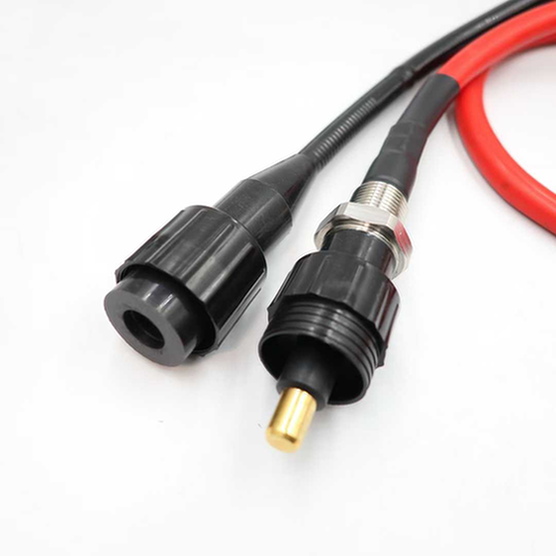
| Número de pines | Aplicaciones típicas | Common Configurations |
|---|---|---|
| 2-4 pins | Power only, simple sensors | 2P (power), 3P (power+ground), 4P (dual power) |
| 5-8 pins | Basic ROVs (power + control) | 6P (3-phase power + control), 8P (power + data) |
| 9-12 pins | Standard inspection ROVs | 10P (power + control + video), 12P (multi-function) |
| 13-20 pins | Work-class ROVs, complex systems | 16P, 19P, 20P (multiple systems) |
| 21+ pins | Specialized applications | Configuraciones personalizadas |
3.2 Current & Voltage Ratings
Power Pins
| Solicitud | Voltaje | Actual | Pin Size |
|---|---|---|---|
| Control signals | 5-24V DC | <1A | Standard (20-22 AWG) |
| Sensors | 12-48V DC | 1-5A | Standard (18-20 AWG) |
| Thrusters (small) | 12-48V DC | 5-20A | Large (14-16 AWG) |
| Thrusters (large) | 100-600V DC/AC | 20-100A | Power pins (10-12 AWG) |
| High power | 600-3000V | 100A+ | Specialized high-power |
Signal Pins
- Digital signals: TTL, RS-232, RS-485, Ethernet
- Analog signals: 0-10V, 4-20mA
- Video: Coaxial pins for SD/HD video
- Fiber optic: For high-bandwidth applications
3.3 Pin Layout Best Practices
Power and signal separation:
- Keep high-current power pins away from sensitive signal pins
- Use ground pins as shields between power and signal
- Consider EMI/EMC requirements for your application
Keying options:
- Mechanical keying (prevents mis-mating)
- Pin layout keying (asymmetric pin patterns)
- Color coding (visual identification)
3.4 Contact Materials
| Material | Conductivity | Resistencia a la corrosión | Coste | Ideal para |
|---|---|---|---|---|
| Brass | Bien | Feria | $ | Low-cost, low-cycle |
| Bronze | Bien | Bien | $$ | Marine applications |
| Copper Alloy | Excelente | Bien | $$ | High conductivity needs |
| Gold Plated | Excelente | Excelente | $$$ | Signal pins, low voltage |
| Silver Plated | Best | Bien | $$ | Power pins, high current |
Recommendation: Gold-plated contacts for signal pins, silver-plated for power pins.
Chapter 4: Wet-Mate vs Dry-Mate Connectors
4.1 Wet-Mate Connectors
Definition: Can be connected/disconnected underwater.
Advantages:
- No need to recover ROV for connector changes
- Modular system design (swap tools, sensors)
- Reduced operational downtime
- Essential for certain applications (tool changes, emergency disconnect)
Disadvantages:
- More complex design (higher cost)
- More potential failure points
- Requires careful maintenance
- Limited pin count compared to dry-mate
Best Applications:
- Work-class ROVs with tool changes
- Multi-mission ROVs
- Emergency disconnect requirements
- Sistemas de producción submarina
Cost:
2-5x dry-mate connectors (depending on pin count and depth rating)
4.2 Dry-Mate Connectors
Definition: Must be connected/disconnected in dry environment.
Advantages:
- Simpler design (lower cost)
- Higher reliability (fewer moving parts)
- Higher pin count options
- Lower maintenance requirements
Disadvantages:
- ROV must be recovered for any connector changes
- Not suitable for subsea tool changes
- Limited operational flexibility
Best Applications:
- Inspection-class ROVs (fixed configuration)
- Tether terminations
- Permanent or semi-permanent installations
- Budget-conscious projects
Cost:
Baseline pricing (1.0x)
4.3 Decision Matrix: Wet-Mate vs Dry-Mate
| Requisito | Wet-Mate | Dry-Mate |
|---|---|---|
| Underwater tool changes | Obligatorio | Not suitable |
| Emergency disconnect | Obligatorio | Not suitable |
| Budget constraint | Challenging | Good fit |
| Maximum reliability | Bien | Better |
| High pin count (>20) | Limited options | Good options |
| Minimal maintenance | Moderado | Bajo |
Chapter 5: IP68 vs IP69K – Which Do You Need?
5.1 Understanding IP Ratings
IP (Ingress Protection) ratings follow IEC 60529 standard:
- First digit (6): Solid particle protection (6 = dust-tight)
- Second digit (8 or 9K): Liquid ingress protection
5.2 IP68 Rating
Definition: Dust-tight + continuous immersion beyond 1 meter (depth and duration specified by manufacturer).
Typical testing:
- Depth: 1-10+ meters (manufacturer specifies)
- Duration: 24-72 hours continuous immersion
- Temperature: Ambient (typically 15-35°C)
Good for: Most ROV applications
5.3 IP69K Rating
Definition: Dust-tight + protection against high-pressure, high-temperature water jets.
Typical testing (DIN 40050-9):
- Water temperature: 80°C ±5°C
- Water pressure: 80-100 bar
- Flow rate: 14-16 L/min
- Distance: 10-15 cm from nozzle
- Angles: 0°, 30°, 60°, 90° (4 positions)
- Duration: 30 seconds per position
Good for: ROVs that undergo high-pressure cleaning after every deployment
5.4 The Reality for Most ROVs
Most ROVs don’t need IP69K. Here’s why:
- Operating depths are the real test: IP68 rated to your depth requirement is more important than IP69K.
- High-pressure jet testing doesn’t match real conditions: IP69K tests with 80°C water at 100 bar. Real ROV operations use ambient temperature seawater at much lower pressures.
- Material selection matters more: A well-made IP68 connector with 316L construction will outperform a cheap IP69K connector with poor materials.
- Seal design is critical: IP rating doesn’t guarantee seal longevity. Compression seals, proper lubrication, and regular maintenance matter more.
5.5 When IP69K Makes Sense
Consider IP69K if:
- ✅ ROVs are pressure-washed after every deployment (biosecurity requirements)
- ✅ Operations in tropical climates with frequent thermal cycling
- ✅ Customer specifications require IP69K (some procurement policies)
- ✅ Connectors are exposed to high-temperature washdown (>60°C)
5.6 Our Recommendation
Focus on depth rating and material selection over IP69K.
For most ROV applications:
- Minimum: IP68 rated to 2x your max operating depth
- Material: 316L stainless steel (minimum), titanium for premium
- Seals: Viton or EPDM (better than standard rubber)
Más información: Technical Specifications Guide
Chapter 6: Subconn Compatibility (The Alternative Question)
6.1 The Subconn Reality
Subconn (Teledyne) is the industry gold standard. But here’s what ROV manufacturers tell us privately:
“We love Subconn quality, but the pricing is killing our margins on small ROV projects.”
“Lead times are unpredictable. We’ve had projects delayed 8-10 weeks because connectors didn’t arrive.”
“For inspection-class ROVs at 200m, do we really need connectors rated for 3000m?”
6.2 Alternative Quality Comparison
| Factor | Subconn | Alternativas premium | Alternativas presupuestarias |
|---|---|---|---|
| Calidad | 10/10 | 8-9/10 | 5-7/10 |
| Precio | $$$ | $$ (50-60% de Subconn) | $ (30-40% de Subconn) |
| Plazo de entrega | 8-12 semanas | 3-5 semanas | 2-4 semanas |
| Cantidad mínima de pedido | Más de 100 unidades | 20-50 unidades | 10-20 unidades |
| Soporte técnico | Excelente | De bueno a excelente | Variable |
| Garantía | 2 años | 1-2 años | De 6 meses a 1 año |
6.3 When Alternatives Make Sense
- ✅ ROV de inspección ((a menos de 500 m de profundidad)
- ✅ Proyectos con restricciones presupuestarias
- ✅ Plazos ajustados (no puedo esperar entre 8 y 12 semanas)
- ✅ Producción de bajo volumen (no se puede cumplir con un MOQ elevado)
- ✅ Aplicaciones en las que se puede acceder al conector para realizar tareas de mantenimiento
6.4 When to Stick with Subconn
- ❌ Aplicaciones en aguas profundas (>2000 m)
- ❌ Misiones críticas (un fallo = pérdida catastrófica)
- ❌ Implementaciones a largo plazo (sin acceso para mantenimiento)
- ❌ Las especificaciones del cliente requieren Subconn
- ❌ Los requisitos de garantía y seguro exigen marcas de primera calidad
6.5 Compatibility Levels
| Tipo de compatibilidad | Qué significa | Nivel de riesgo |
|---|---|---|
| Compatible pin a pin | Sustitución directa, misma superficie de acoplamiento | Bajo |
| Compatible con Form-fit | Las mismas dimensiones; es posible que sea necesario realizar pequeños ajustes | Medio |
| Funcionalmente equivalente | Las mismas especificaciones eléctricas, pero diferentes en cuanto a la mecánica | Alto (requiere rediseño) |
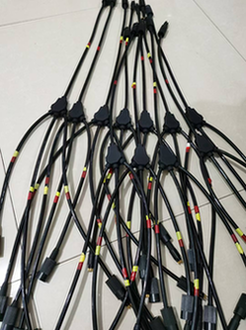
Comprueba la compatibilidad: Conjuntos de cables submarinos
Chapter 7: Supplier Evaluation (7 Critical Factors)
Factor #1: Depth Rating & Certification
Verify with independent test documentation. Don’t accept “trust us.”
Factor #2: Corrosion Resistance
316L minimum for saltwater. Request salt spray test reports (1000+ hours).
Factor #3: Lead Time & Reliability
Standard: 2-4 weeks. Custom: 4-8 weeks. Get commitments in writing.
Factor #4: MOQ Flexibility
Reasonable: 10-50 units for standard products. Sample programs should be available.
Factor #5: Technical Support
Engineers on call, <12 hour response. Not just sales support.
Factor #6: Compatibility
Cross-reference charts for Subconn, Seacon, Teledyne ODI.
Factor #7: Price (Total Cost of Ownership)
Cheapest connector often costs 3-5x more over its lifetime. Calculate TCO.
Full evaluation guide: Request Supplier Evaluation Checklist
Chapter 8: Red Flags (When to Walk Away)
🚩 Can’t Provide Test Documentation
“Trust us, it’s been tested” = walk away.
🚩 Vague About Lead Times
“Soon” or “ASAP” instead of specific dates = unreliable.
🚩 No Technical Support
Only sales support, no engineer access = you’re on your own.
🚩 Unwilling to Provide Samples
No sample program = no confidence in their product.
🚩 Pressure Tactics
“This price is only good today” = high-pressure sales, walk away.
🚩 No References or Case Studies
Can’t disclose any customer names = no verifiable track record.
🚩 Unclear Warranty Terms
Vague warranties = no warranty. Get it in writing.
Chapter 9: Case Studies
Case Study #1: Portuguese ROV Integrator
Challenge: Subconn costs eating 22% of BOM, 10-12 week lead times.
Solution: HYSF pin-compatible alternatives, 35% cost reduction, 3-4 week delivery.
Result: Zero failures in 18 months, won 3 new contracts.
Case Study #2: US Research Institution
Challenge: Education budget constraints, student turnover.
Solution: HYSF education discount (30%), standardized connector selection.
Result: 40% cost reduction, zero failures in student projects.
Case Study #3: Norwegian Aquaculture ROV
Challenge: Connectors corroding every 4-6 months.
Solution: Upgraded to 316L with proper maintenance protocol.
Result: Zero failures in 24 months, 60% maintenance cost reduction.
Más información: Casos prácticos de clientes
Chapter 10: Ready to Select Your ROV Connectors?
If you’re building ROVs, you deserve a connector supplier that:
- ✅ Entiende tus retos particulares
- ✅ Ofrece precios competitivos sin sacrificar la calidad
- ✅ Entregas puntuales, siempre
- ✅ Provides real technical support
- ✅ Stands behind their products
Qué ofrece HYSF Subsea
- Muestras gratuitas for qualified projects
- Respuesta al presupuesto en 12 horas
- Cantidad mínima de pedido reducida from 10 units
- Compatible con Subconn options
- Entrega en 2-3 semanas
- Acceso directo para ingenieros
- 316L stainless standard (titanium upgrade)
- Clasificación IP68 to 50m+ (custom depths)
- Garantía de 1 a 2 años
Próximos pasos
Contacto: info@hysfsubsea.com | +86 13942853869
About: John Zhang is CEO of HYSF Subsea. HYSF has supplied connectors to ROV manufacturers in 30+ countries since 2015.
Last reviewed: March 12, 2026 | Next review: June 12, 2026








 English
 Spanish
 Russian
 French
 German
 Korean
 Japanese
 Arabic
 Thai
Thai Danish
 Norwegian